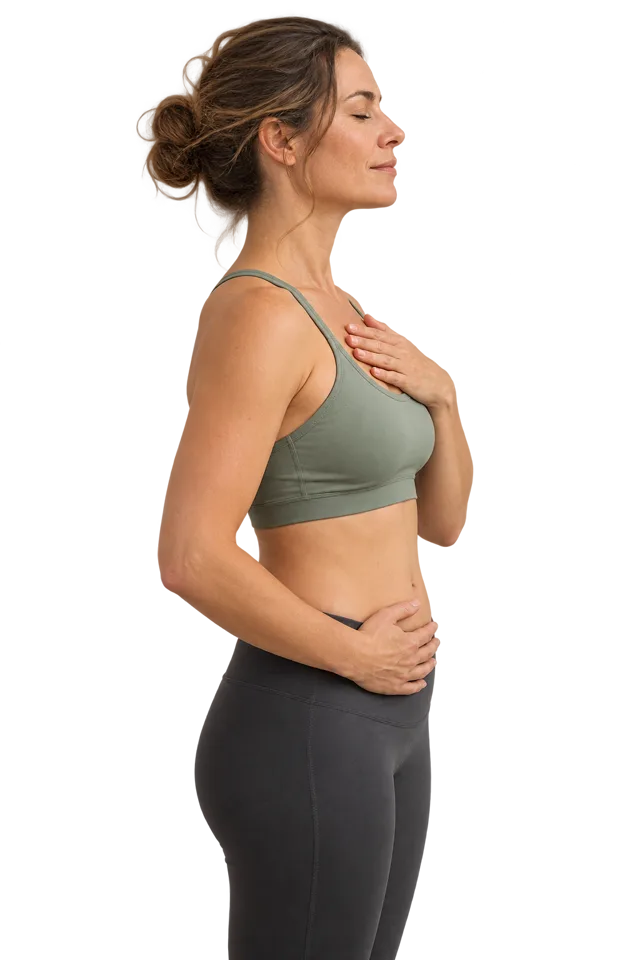
Breathing practices involve more than the chest. The navel moves gently forward on inhalation and returns towards the spine on exhalation. This small movement underlies the techniques explored here. The guide explains why and introduces noticing it from the first few minutes.
No sign-up. Read the guide and try the practice right here.
01 · Getting acquainted
The breathing navel
Rest a hand on your abdomen just below the navel and breathe. On inhalation, the abdomen gently expands forward; on exhalation, it draws back and the navel seems to approach the spine. If your hand feels this, you are already using diaphragmatic breathing. In kundalini yoga, it is called navel breathing: attention rests on the navel point rather than the chest.
The navel serves as a reference point. You are not “pumping up” your abdomen or pressing on it. Notice how the abdominal wall moves with the diaphragm. The same mechanics are visible in a sleeping adult or an infant in a cradle: the abdomen moves on its own when habitual chest breathing does not interfere.
You do not need to breathe deeply straight away. First, notice the movement of the navel. It is already there, although it usually goes unnoticed.
02 · Physiology
What happens in the body
The diaphragm is a thin muscular dome between the chest and abdominal cavities. As you inhale, it contracts and descends, displacing abdominal organs downwards and forwards, which allows the abdomen to expand. As you exhale, the diaphragm relaxes and rises as the organs move back; the abdomen draws in and the navel moves towards the spine. Physiology describes this as the diaphragm’s respiratory excursion, with movement of the navel as its visible trace on the front of the body.
Movement of the navel is an indicator of function. As the diaphragm descends, it increases the volume of the chest cavity, creates negative pressure and assists blood returning to the heart. Breathing that involves the abdomen engages the lower parts of the lungs, which are used less during chest breathing. Reviews of slow breathing describe increased vagal influence and heart rate variability, a measure associated with the nervous system’s flexibility between effort and recovery.
Deep breathing is often said to “massage the internal organs” or “move lymph.” There is a plausible mechanism: rhythmic changes in abdominal pressure do affect venous and lymphatic flow. Direct clinical evidence for these effects remains limited, so they are presented here as a hypothesis.
On inhalation, the diaphragm descends and the abdomen moves forward. On exhalation, it rises, the abdomen draws in and the navel moves towards the spine.
The navel moves as the diaphragm moves. Navel breathing offers a way to observe whether the diaphragm is involved.
For an introduction, lie on your back with your knees bent and lower back relaxed. Place one hand on your chest and the other on your abdomen just below the navel. Inhale through the nose: the hand on the abdomen rises while the hand on the chest barely moves. Exhale through the nose or mouth for a little longer: the abdomen lowers and the navel gently returns inward. Begin with five to seven cycles, once or twice a day.
If the abdomen does not move, do not force it. Rest a small book or the edge of your hand on the abdomen and observe it rising on inhalation and falling on exhalation. Some people find the image of a balloon helpful: it expands on inhalation and deflates on exhalation. Let the mechanics emerge without forcing your body.
Lie on your back with knees bent and hands on chest and abdomen.
Inhale through the nose; the hand on the abdomen rises.
Let the exhalation be a little longer; the navel gently returns towards the spine.
Take 5–7 cycles, then return to normal breathing.
Straining is counterproductive here. If the navel does not move during the first few days, allow time: the body may have spent decades breathing another way.
Once you can notice the basic movement, observe it in a breathing technique. In “Ocean” and “Even rhythm,” the navel moves forward on inhalation and back on exhalation alongside the circle. In “Square” and “Longer exhalation,” the abdomen stays quiet during holds, while the navel returns towards the spine on exhalation. Select “Show the movement” below to see a side view of the abdomen and hand moving with the breath.
The idea is simple: if the abdomen stays completely still in practice, breathing may be concentrated in the chest. This is not a judgement or a failure; it is a cue to revisit chapter three for a couple of days. With time, noticing the navel’s movement may become familiar even when your attention is on a mantra or meditation.
In a study teaching adults diaphragmatic breathing, participants showed lower salivary cortisol and improved sustained attention after eight weeks of practice. This does not mean that a single exercise will transform how you feel. It offers evidence that the skill itself can be studied and measured.
The navel is a compass for this practice. It shows how breathing is moving through the body, even when everything seems to be going correctly.
In the kundalini yoga tradition Elena teaches, the navel centre is one of the key areas of practice. In the teaching, it is called nabhi and is located roughly two to three centimetres below the navel. The tradition describes it as a centre of energy transformation and willpower, associated with the third chakra, manipura. This is a traditional teaching that gives direction to the practice.
Many kriyas focus on this centre. In “breath of fire,” rhythmic inhalations and exhalations are accompanied by light, quick inward movements of the navel on each exhalation. In Sat Kriya, the navel is drawn in on “Sat” and released on “Nam.” The tradition sometimes calls a strong navel centre a “steel navel,” describing it as holding the energy of the practice rather than allowing it to disperse.
Navel breathing is treated as a foundation for further work. Learning to notice its movement at a calm pace prepares the ground for more intensive techniques: breath of fire, Sat Kriya and nabhi kriyas involve this area too. The guides on breathing, meditation and gratitude can take on another dimension when bodily awareness is part of the practice.
Here, as in the other guides, tradition is presented as tradition: the accumulated experience of a school. The experience of practice remains real regardless of how it is explained.
Navel breathing is gentle, but it has limits. Do not force abdominal movement during pregnancy, in the first days of menstruation, with hernias or soon after abdominal surgery. If you have high blood pressure, cardiovascular disease, epilepsy or glaucoma, discuss techniques involving holds and strong abdominal contractions with a doctor before practising. These are precautions for breathing practices.
Attention to signals matters more than any technique. Dizziness, tingling fingers, nausea or growing anxiety are reasons to stop and return to normal breathing. Abdominal pain from effort is not needed: the navel returns through natural mechanics. If discomfort recurs, discuss practice with a professional rather than extending its duration.
Questions for yourself
How did my abdomen feel before practice? Was it tense?
Did the navel move freely, or was I trying to force it?
With time, movement of the navel may need less conscious attention: diaphragm and abdomen work together in the background of practice. In a practical sense, this is one way to understand an “activated navel centre”: familiar mechanics together with bodily awareness. It offers a foundation for meditation, breathing cycles and kundalini yoga practices in which the tradition speaks of the body’s inner fire.
To explore how it works alongside movement, try “Ocean” after a week of navel breathing and notice whether the abdomen continues to move with the wave sound. Observe without judgement. If it becomes still, revisit chapter three for a few more days.
This guide is an entry into the series. Gratitude explores directing attention, meditation explores staying with it, and breathing explores rhythm. Navel breathing connects them through the body and the centre that the tradition associates with manipura.
Make yourself comfortable. Place one hand on your chest and the other on your abdomen, then compare their movement. In the animation, the abdomen and the hand resting on it move together while the head and shoulders remain still. Movement is slightly exaggerated to make it visible.
Make yourself comfortableSit with support or lie on your back.
Rest your handObserve your abdomen while keeping your shoulders relaxed.
Notice the movementThe abdomen gently moves forward on inhalation and slightly inward on exhalation.
Watch the lower hand moving gently with the abdomen. The highlight helps you follow this area.
Abdominal movement
Observe the hand
On inhalation, the abdomen expands gently. On exhalation, it returns inward towards the spine. The movement at the end of exhalation is exaggerated for clarity; do not draw the abdomen in through force.
InhaleThe abdomen and hand move forward
ExhaleThe abdomen and hand gently return inward
Demonstration: 4 seconds to inhale and 6 to exhale. You can simply watch and breathe at your own pace.
If you feel dizzy or uncomfortable, stop and return to normal breathing.